16/10/2015

3 Passive Income Streams & My Facebook Page Earnings Update

3 Passive Income Streams & My Facebook Page Earnings Update

Link to 2 Create a Website Blog

3 Passive Income Streams & My Facebook Page Earnings Update

Posted: 15 Oct 2015 09:25 AM PDT

Making Passive Income With Your Website

This podcast discusses three of my passive income sources: T-shirt sales update (via my new Facebook niche page), GoDaddy and Udemy (courses).

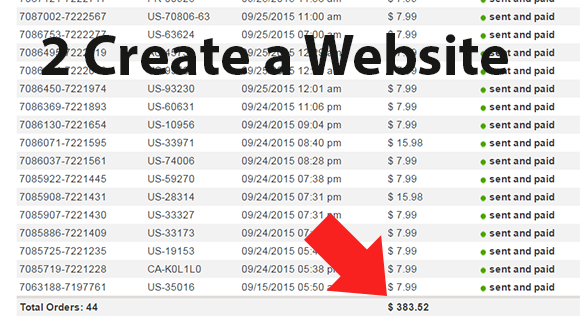
I had a small breakthrough with my Facebook experiment during the last week of September, and in just 36 hours, it generated over $350 in T-shirt commissions.

Spreadshirt Orders

Now sales are starting to come in a little more regularly. Plus, I gained more than 2500 organic (free) likes since the last podcast.

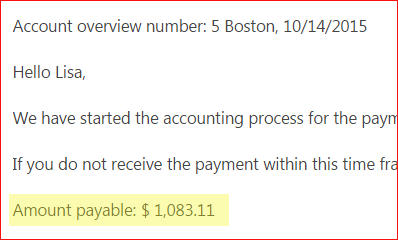
Thanks to this page, I received my largest payment from Spreadshirt to date. Now it’s time to get ready for the “ugly Christmas sweater” season!

Record Spreadshirt Payment

This is exactly what I love, love, love about Internet Marketing. There are so many ways to earn, and they don’t always have to involve the conventional methods (content publishing, blogging, etc.)

Since earning with Spreadshirt for the first time last year, I’ve been completely obsessed with the T-shirt monetization model. I was determined to scale this somehow, and it’s finally starting to pay off.

The bonus?

I’m having FUN doing it — always a prerequisite for me or I’ll give up too soon.

I’m a very right-brained person, and I like to tap into my creative side when I can. Coming up with the ideas and funny sayings for the shirts is what makes this fun and challenging.

The Lesson: If you enjoy doing something, stick with it! Usually it takes a little time to reap the rewards.

Note: If you don’t want to listen to the podcast now, you can right-click this link, Save As and download it for later.

Feedburner users can click here from your email to listen.

In This Podcast

  • My earnings with the Facebook niche page experiment after 2 1/2 months
  • The right way to post an image on Facebook to get a better reach
  • Why my 2nd FB page attempt proves I’m not ready to formally teach this yet
  • Get more details on my highest earning program and how you can earn too
  • Is it better to become a hosting affiliate or reseller?
  • Updates on my experience with Udemy after one full year and my goal for 2016

Show Notes

29/09/2015

Do You Need Backlinks to Rank? Why Opinions Vary

Do You Need Backlinks to Rank? Why Opinions Vary

Link to 2 Create a Website Blog

Do You Need Backlinks to Rank? Why Opinions Vary

Posted: 28 Sep 2015 09:13 AM PDT

Why People Disagree Over Backlink Building

You keep asking for it!

So I’m doing this post for those of you who want to learn more about why your website is not ranking for your targeted keywords. I’ll also explain why some people say you need to build backlinks and others say you don’t.

And finally, I’ll update you on my experiment I started in July, 2013 where I built up search traffic without any backlinks at all.

Understanding Backlinks

By now, you’ve probably heard or read that if you want to rank on Google, you need backlinks.

A backlink is a link from one site to another. In Google’s eyes, backlinks are votes for your site.

How many you need for worthwhile traffic depends on how competitive the keywords are, the quality of the backlinks you receive and your site’s Domain Authority.

Domain Authority (DA) is a metric that was developed by Moz, and it takes into account domain age, popularity, etc.

Domain Authority Definition

If your site’s DA is 90 (the max is 100), it will be much easier for you to rank for a medium or even highly competitive phrase, compared to a site that has a DA of a 30.

I use Long Tail Pro (affiliate link) to check DA because it shows you the values for the top 10 results for any keyword search.  It helps you easily gauge how competitive a niche or keyword phrase is.

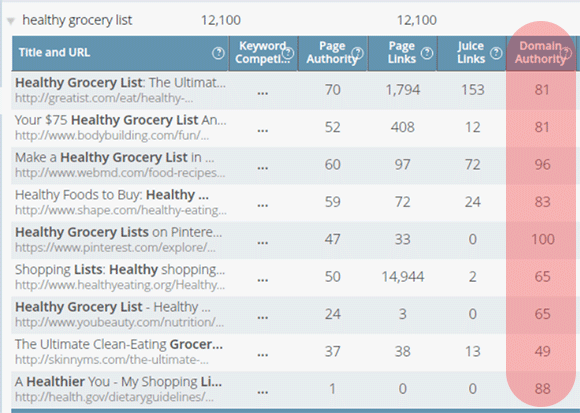
In the screenshot below, the keyword “healthy grocery list” gets a decent amount of searches per month, BUT look at how high the DAs are for the websites in the top 10. That would be a tough phrase for a new or unpopular site to rank for.

All the DAs are medium to high, and there are no websites ranked in the top 10 with a DA below 40.

Long Tail Pro Example

You can also check the DA of individual domains for free using this site.

So the reason some of you are struggling with organic Google traffic is you are going after keywords you will never, ever be able to compete with because your site’s authority is too low and you’re targeting keywords that are too competitive.

Sean Has Had It and Is Now Building Backlinks

Now let’s talk about getting backlinks. Should you build them? What about earning them naturally over time?

Website Babble member, Seanguy is changing his approach. He’s tired of working hard on his content and seeing new competitors with lower quality content rise above him in the search results. He concluded through research that they are building links manually.

Building backlinks means you seek out ways to get people to link to your site instead of letting it naturally happen over time. This could mean you email other site owners and ask them for a link to your site on their research page or create an Infographic and ask other bloggers to link to it.

There are many ways people build links and Sean is on a mission.

So he created a very honest post on the forum back in August about how he is going to start building backlinks because he believes that’s the only way he is going to compete.

Seanguy

Many of you know I’m not a fan of this approach, but I can also understand why people resort to it. It’s super frustrating to see websites with lower quality content outranking you.

After all, the search engines are bots. They aren’t humans. So they will never get it 100% right with regards to ranking websites.

How many of you are frustrated with your competitors like Seanguy?

Choosing Long Tail Keywords Require Fewer/No Backlinks

I can tell you from experience that you can build traffic without manually building links if you go after long tail keywords.

It doesn’t work as well as it did years ago, but well enough to make what I call “passive side money” without building backlinks.

A long tail keyword is a very specific phrase that gets searched for much less than a more competitive one. So if you have a site about weight loss, a keyword like “how to lose weight” is too competitive due to the number of monthly searches and the big brands ranking in the top 10.

But a long tail keyword like “how to lose weight drinking tea” is more specific and less competitive. So the idea is you methodically write posts that target less competitive phrases.

I attended a webinar recently and one guy said he only goes after keywords that get searched for less than 100 times per month, and his site consistently gets 2,000 visits per day using this method.

So even though you may only get 5 visits per day from these keywords, they are much easier to rank for, and if you repeat the process across multiple keywords, the traffic adds up over time.

So that’s all fine and good, but the argument to this approach is many of these keywords you can rank for today are not “money keywords” – meaning they don’t generate traffic that easily converts into sales.

A valid argument indeed, but this strategy is still worth implementing.

I WOULD NOT SUGGEST BUILDING YOUR PRIMARY SOURCE OF INCOME THIS WAY.

My SEO Experiment With The Long Tail

You may remember my experiment I started back in July of 2013, where I was able to build traffic up to 500 uniques per day in about 6 months. I didn’t manually build backlinks. I just wrote keyword-focused content.

I made the site anonymous to keep the stats pure, and even created a separate Google Analytics account just to make sure the nothing I have currently done will influence the ranking in any way. (At the time, Google Authorship was still live and kickin so I wanted to make sure I didn’t have anything linked to my sites.) I didn’t even use AdSense.

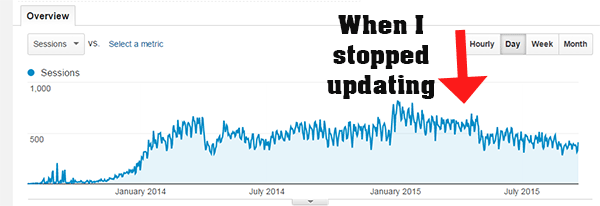
It took me about 6 months to rank on page 1 (position #7) for my main seed word. The traffic peaked in January, 2015 at 800 visitors per day, but as you’ll see below, it didn’t last.

That traffic may not sound very impressive, but if you take into account that I put in a total of 10 hours (mostly in the first 2 months), it’s not too shabby. I just wish I had chosen a niche I was more interested in. The results would have probably been more impressive because I’d have more content.

I did outsource content for a few months on TextBroker just to keep traffic up, but stopped earlier this year.

That site still exists and is getting around 400 unique visitors per day, and still generating passive affiliate income. I only added one article this year, which is no doubt a reason for the big dip in traffic. Most of the content was added in 2013 and 2014.

Here’s a screenshot of the traffic to the site starting in July 2013 to now.

Traffic Graph

That surge in traffic you see at the very beginning of the graph in August 2013 was something I was trying with Pinterest and Pinwoot. DON’T GO TO PINWOOT. I just tried to pull it up and got a Norton warning. Yikes!

Since I wasn’t building backlinks I wanted to try something with social media just to get the site on the map. I earned credits on Pinwoot by sharing other people’s content on Pinterest. In return, other people shared mine. So the traffic was coming from that Pinwoot experiment.

As you can see it took a good 6-7 months (January 2014) for the Google traffic to pick up. That’s a lesson in why you don’t give up after 2-3 months. It takes time!

I will probably have my V.A. (virtual assistant) start updating the site regularly again because the income is worth keeping the site around. As you can imagine, the earnings have dropped off with the decrease in traffic.

This was the first site where I methodically created content with SEO in mind on every page. It felt a little weird and robotic because I normally choose content based on interest, not keywords, and let the ranking chips fall where they may.

I understand why people do keyword research before writing content, but geez it is incredibly tedious! I’ve never been a fan of doing all the research. I just want to write and forget about keywords! :-)

But since this was an experiment, I decided to be more deliberate with my approach.

Why Link Building Stories & SEO Advice Varies So Much

You may have read stories about people (like me) building traffic without fussing with backlinks. On the flip side, some people will tell you that you MUST build them. It’s often an ongoing part of their site upkeep.

So why the inconsistent advice and suggestions across the Web about backlinks?

There are many reasons…

  • Some people get lucky and have an interest in niches that don’t require as many backlinks due to low competition. So they take a topic and run with it.
  • People get into a niche early before it gets too crowded.
  • Some are just insanely creative/useful with their content, videos, social media, etc. and have no problem getting followers and links naturally. They don’t need to build backlinks.
  • Others really take time to do the research and understand how the long tail works. They strategically choose niches and select keywords for each article very carefully.

And here’s a big reason link building stories vary: I’ve learned through my own experience that certain niches are more sharable.

Visual Niches Have Link Building Advantages

What I mean is the people in the niche are on social media more and sharing happens more frequently. I’ve found this to be true with visual topics like hair, makeup, fashion, beauty, etc. It’s just the nature of the topics. Not all niches have that advantage.

The site in my experiment did not have that advantage, but when you choose the right keywords, you can rank without backlinks.

So yes, opinions vary for many different reasons. Someone like me is going to tell you to not to build backlinks because I’ve had moderate success. Obviously my opinion is greatly influenced by my own experiences.

Your Expectations & Goals Matter Too

How much traffic and income are you seeking and what do you define as success? This will also influence your outlook. Is 500 visits per day enough? Are you looking to live off the income?

I was very satisfied with my experiment results given the minimal time invested. I never expected to make a living with these kinds of sites in 2015.

So if you’re looking to make significant long-term income, then you may have a different perspective on all this.

Where Do You Stand?

I was wondering how many of you feel like Seanguy and have given up on the “build and they will come” philosophy for SEO? Or do you even care about SEO anymore?

I’m also posting this to gauge interest in videos on understanding how to use the long tail with Long Tail Pro (affiliate link). You don’t need this software for research, but it speeds up the research process for keyword selection.

When I make suggestions for products people need to make money online, I often categorize them in two ways: necessities and luxuries. Paid hosting, in my opinion, is a necessity. Long Tail Pro would fall in the Luxury category.

If you can afford it, grab it. If you can’t, use free tools like The Google Keyword Planner. You just won’t get the additional info about competition (domain authority, backlinks, etc).

I get the sense a lot of you have given up on SEO (search engine optimization) and have opted to focus more on diversification through podcasting, social media, live streaming, YouTube, etc. No doubt that’s the best approach for sustainable success, but some of you may still focus on SEO.

No matter how much I preach about traffic diversification, there are always people who simply want to focus on Google traffic.

That’s your right, and I get why it’s so desirable. It can lead to a lot of passive income, but it comes with huge risks if that’s the ONLY way you plan to build traffic.

Where do you stand with all this? Are you also frustrated with not being able to rank? Are you noticing your competitors building backlinks? Or have you moved away from SEO?

You can follow Seanguy’s backlink building journey on Website Babble.

16/09/2015

Struggling With Traffic? Don’t Dismiss Facebook Ads Until You Hear This

Struggling With Traffic? Don’t Dismiss Facebook Ads Until You Hear This

Link to 2 Create a Website Blog

Struggling With Traffic? Don’t Dismiss Facebook Ads Until You Hear This

Posted: 15 Sep 2015 08:26 AM PDT

How to Get Cheap Facebook Likes and Awesome Engagement

If you’ve already made up your mind and you have no interest in Facebook ads, I’ll see you in the next post! Ha!  :)

However, if you need traffic, I hope you listen to this podcast with an open mind before disregarding the concept.

Like a lot of you, I had no interest in spending money and supporting Facebook by buying ads. But after I learned more about “the ad system” this summer, I am singing a different tune.

And if you are struggling with traffic, this podcast will offer new insight and give you something to try.  And no, you don’t have to spend a lot of money.

Anyone who says you have to spend 20 or 30 cents per like is doing something very wrong.  You can still get U.S. likes for under 10 cents. It’s all about the image and targeting.

You may remember my post about building Facebook niche pages to sell shirts.  Let me be honest. That model is getting saturated, and it’s going to cost the average person a good amount of money to make money.

That’s NOT the focus of this podcast.

Instead of trying to directly monetize the pages, you can use the the page to build up an audience for your website and email list.  And if you’re worried about buying traffic that will never see your content, worry no more.

There are simple things you should do from the very beginning that I wish I had done with my page for this site.

Start engaging fans early and often. This helps keep your engagement high and you can enjoy stats like this…

Awesome Facebook Engagement

The above page was just created in July and only has 3700 total page likes.  I’ll explain in the podcast how I created the ad to keep the cost per like down, and how I’m keeping engagement up.

Right click this link and “Save As” to download podcast.

In This Episode

  • How I averaged 7 cents per like for U.S. traffic across all my niche pages
  • The key ingredient I use in every ad to keep the cost down
  • Where people go horribly wrong with targeting people’s interests on Facebook
  • Ad image tips that get people’s attention
  • Why you should target women instead of men (if relevant for your niche)
  • Learn why age matters
  • How to keep your engagement high so your fans actually see your content

Show Notes

25/08/2015

Don’t Ignore The Latest Google AdSense Notice – The Deadline is Sept. 30th

Don’t Ignore The Latest Google AdSense Notice – The Deadline is Sept. 30th

Link to

Don’t Ignore The Latest Google AdSense Notice – The Deadline is Sept. 30th

Posted: 24 Aug 2015 08:01 AM PDT

Does Your Site Comply With the EU User Consent Policy?

You may have received a notice from Google AdSense reminding you to ensure your site complies with the EU user consent policy. You have until September 30, 2015.

European laws require that digital publishers give visitors to their sites and apps information about their use of cookies and other forms of local storage. In many cases these laws also require that consent be obtained.

If your site has visitors from any countries in the European Union (and that’s pretty much everyone), this applies to you.

This isn’t new.  The EU has had regulations related to cookie-related data collection for a long time.

What’s new is that Google will be applying this its own services.  This includes AdSense, DoubleClick for Publishers, etc.

Does all this legal and policy talk make your eyes cross?  I know, me too.  But hey, we have to pay attention to these things.

I Can’t Tell You What to Do

This is a tricky post for me to write because I can’t tell you specifically what to do or how to word your consent policy, and neither will Google.  I haven’t even decided how I’m going to approach this yet.

The Google AdSense Team recommends seeking out legal advice to ensure the wording is correct for your site, app, etc.  But let’s face it, how many publishers are really going to do that?

I’m being careful how I word this post because I don’t want to be responsible for any actions taken on your AdSense account as a result of my recommendations. I’m just the informant.

I hate to be all vague-a-liscious here :-), but hey, I tread very carefully when it comes to this legal and policy stuff.

The Verbiage is Tricky

The word AdSense Publishers keep getting caught up on is “consent.”

Does that mean our users must physically “accept” some kind of message or is a warning enough?  Some believe a visible warning is fine, others are taking it more literally.  There seems to be a lot of confusion surrounding this.

Also, does this warning need to be as aggressive as a pop-up?  Does it need to be visible on your site at all times?  Is adding a snippet to your privacy policy enough?

The answers aren’t really clear at all, but it sounds like we need to do more than just add a snippet to our privacy policy pages.

The good news is there are plenty of plugins out there that will help you add the consent message.  The question is, what should that verbiage be?  Obviously it depends on the kind of site you have, and that’s where it gets murky.

If you go to Google’s help page regarding this, they send you here for information and options (plugins) to help your site comply.  The page was actually created by Google to aid publishers with compliance.

Have you updated your site yet? What are your thoughts?

18/08/2015

Why I Stopped Complaining About Facebook’s Declining Fan Page Reach

Why I Stopped Complaining About Facebook’s Declining Fan Page Reach

Link to

Why I Stopped Complaining About Facebook’s Declining Fan Page Reach

Posted: 17 Aug 2015 09:30 AM PDT

Before You Complain About Facebook's Reach...

If you had told me three months ago that I would be spending my summer investing money in Facebook ads, I would have asked if you were on something. 😉

Like many of you, I’ve watched my page’s reach decline due to the big Edgerank algorithm update in 2013.

If you didn’t know, they significantly lowered the percentage of your fans who see your content because they want people who can’t engage their audiences to buy ads.

Well even before the update, I never had the most engaged Facebook page.  Some of that was my fault, though. I never updated it more than a few times per week.  I also wasn’t posting content that was interesting enough because if I was, more people would have been engaged, right?  Hey, it’s the truth!

I cannot put all the blame on the algorithm update.

Well as you can imagine, the engagement just got worse after the change two years ago.   So the LAST thing I was thinking about was paying money to buy an audience that would potentially never see my content.

Well I’ve changed my tune after some testing.  I had a complete mental shift with regards to how I look at Facebook.

Here’s What Changed My Mind

In mid July, I attended a Teespring meetup.  It was absolutely the most valuable meetup I’ve ever, ever attended, and I’ve been going to these events for four years now.  I usually attend meetups about WordPress, marketing, etc. but I was getting bored with many of them.

To be honest, I’ve been getting bored with many of the topics I’ve been known to blog and vlog about, so this was a much needed meetup on MANY levels!  I wanted to learn and do something new.  Plus, I’m super intrigued by the T-shirt monetization model.

football

Well, when I saw that Teespring was having a meetup I was pumped. I have been doing very well with Spreadshirt (my latest addiction), and had just tipped my first Teespring campaign with Facebook ads.

Don’t worry. If you’re not interested in making money with shirts, that’s not really the point of this post.  It’s really about getting cheap FB likes and building up an engaged page for your website or to sell a product. It just so happens that Teespring is what got me roped into all this.

I met several people at the meetup who make a living with Teespring and Facebook, and they had so much valuable information to share.  I went home and started implementing some of the tips and saw immediate results with buying cheap, targeted Facebook likes for a new page.

Teespring’s Influence on My Mental Shift

First… here’s the skinny on how Teespring works…

You make money by running limited-time T-shirt campaigns, but unlike Spreadshirt, Zazzle etc. you have to sell a minimum amount in X days before you get paid.  The short-term income potential is much greater than the other shirt affiliate programs.

Most people who are successful do the following…

Nursing Shirt

  1. Buy Facebook ads and target people who would be most interested in the shirt (i.e. you create a shirt for female nurses and target females who have “nursing” in their Facebook profiles)
  2. Market to their existing niche Facebook page

Well, I had only tried method #1, and I had 10 failed campaigns before finally tipping.  This method can also get very expensive if you aren’t good with FB ads and you don’t set small budgets. Fortunately I always set very small budgets, so I didn’t lose too much with those 10 campaigns.

Nevertheless, I grew tired of running so many failed campaigns, and didn’t want to spend any more money with this method.

At the meetup, I noticed a lot of the successful “Springers” were not buying ads at all to sell their shirts.  They were just marketing to their existing niche Facebook pages and their customer list. (Once you start selling, you can advertise to existing customers you’ve earned using Teespring’s messaging feature.)

I hadn’t tried the “Facebook niche page” method yet, and it was primarily because I knew about the Facebook reach situation.  Why spend money on people that will never see my content?  No way!

Then I had a mental shift.  What if I invest $50 to $100 in building up a new page, learn to get the cost per like REALLY low for my ad, and work hard at page engagement.  Then I’ll have an audience to market to, and won’t have to keep buying ads for every campaign.

Let’s face it.  Despite all the complaints about Facebook’s declining reach, there are still thousands of people out here profiting on the platform with a great reach, and/or drawing traffic back to their own sites, building their email list, etc. all thanks to their page.

Why do you think Facebook hasn’t changed their algorithm back to the old one?  Because it’s working for their bottom line – A.K.A. advertising dollars.  They’ve got to please their shareholders, not us!

So I thought…Let me stop complaining about the Facebook of YESTERDAY and see if I can capitalize on what Facebook is TODAY.  Who cares if only 50% of people see my page as long as I’m making a profit, right?

Big mental shift for me!

Buying Likes for a New Page

Since my goal is to sell shirts, I did some research on niches that appear to buy a lot of shirts and made my selection.

On July 19th, I sat down and created a brand new Facebook page and began running my first ad to get likes.

I budgeted $100 and hoped to get at least 1,000 likes.  In other words, my goal was to pay no more than 10 cents per like — even though I had read that’s hard to do in 2015.

When the campaign started, I was paying 14 cents per like.  That was actually the best I’ve ever done, but still too high for my taste.  So I let the ad run all day to see if it would improve, and by the end of the day it was down to 6 cents.

The more likes you get per ad view, the less you pay for a like.  So that’s why my cost kept decreasing.

After 11 days, I spent a little over $100 total (I set a daily budget) and had 2400 likes with an average cost of 5 cents per like (U.S. traffic only).  I haven’t spent any more on ads for this page.

5 cent cost per like

As you can see from the image above, almost 2000 of those likes are paid, the remaining 400 likes came organically while the ad was running. Facebook recommends your page to the friends of the people who recently liked your page.

I used Facebook’s Audience Insights tool to ensure my audience was laser targeted, and I worked hard at making sure the image and text in the ad were relevant and spoke directly to that audience.

Notice the relevancy in the ad is 10.  That’s a measurement of how relevant my ad is to the audience I targeted.  This is super important.  Ten is the max, and the higher the relevancy the less you pay.

One month later, this page has 3200 likes (the remaining 800 are all organic).

What About Engagement?

In short, it’s amazing.

I posted an ecard meme (people really, really love those!) on August 6th and the reach for the post is now up to over 200,000.  Yes, the reach (number of people who see the post) is higher than the number of likes on the page! Each post averages over 100-150 likes.

Facebook Reach 2229K

Notice the above post has almost 1,000 likes, 1800 shares and check out the reach.  I swear, 229,000 is probably my total engagement for the lifetime of my 2 Create a Website page!!! :-) :-)

So how can you have a reach higher than the number of likes on the page?

When you post something that has such great engagement, Facebook will continually show it to most people who are logged on and like your page.

Some people will see the post multiple times.  And if it gets REALLY good engagement (likes, comments, shares, etc.) then Facebook will also show it to their friends who haven’t yet liked the page.  This also helps to build your likes organically.

Here’s another post from two days ago…

53K Reach

Could I Do This Again?

I wanted to so see if I could replicate this and create more pages.  By this time, I’m starting to consider doing a course on this, and I need to make sure this isn’t just a one-time thing.

I started my 2nd page last week, and it was more of a challenge to get the cost down so I didn’t spend as much. It’s in a competitive space (advertising wise), but less saturated with shirts, so I am committed to building this up. It’s also a very passionate audience that I really want to sell to.

I spent about $36 for 300 likes. I got the cost down to 12 cents per like, but started off at 28 cents per like. Yikes!  I stopped the ad immediately, and tweaked the image to get the cost down.

But here’s what’s crazy.  The engagement per post is almost as good as my 2 Create a Website page that has 18,000 likes!!

Like my first page, the average reach is often higher than the number of likes.  At the time I’m writing this, it has 417 likes and look at the reach from a recent post…

Facebook Reach

And another post…

Facebook Reach

400 Likes

This audience also shares posts a lot more than the first page I setup.  It’s interesting to see how different audiences have different behaviors.  Shares are so important for your reach because it helps keep it strong. I think they are even more important than likes with regards to the FB algorithm.

The reason I’m pointing this out is people often complain (and I used to as well) that you can’t get most of your fans to see your content on Facebook and that’s simply not true.  I’m working hard at posting regularly and getting the engagement going EARLY ON to not only keep these people engaged, but hopefully draw in more people organically.

The biggest mistake I made with 2 Create’s page is never really working hard at engagement from the start. As a result, I have a lot of people who liked the page years ago who have never been engaged.  So they are pretty much worthless likes now.

Plus, unlike the 2 Create page, these are NICHE pages.  2 Create a Website is not really a niche site because I post about so many different subjects, and the audience has many different needs and interests.

Going niche is ALWAYS best, and will give you better results.

If you’re doing this to sell shirts, you also want to focus on finding niches that have very passionate audiences.  That also helps with engagement.

This is all working on autopilot as I’ve scheduled posts a month in advance on all the pages.  I’m auto posting about 2-3 times per day, so it’s practically maintenance free.  Most of the content is just images and memes related to the niches.  I also check in daily to respond to any comments.  I’m going to talk more about engagement in the next podcast.

My third page started out with 1 cent per like, but eventually averaged 5 cents once it got going.  I only spent $10 on that page (193 likes) because I realized I’m running out of info to post to build up engagement.  In the future, I’m going to make sure I do this with pages that I have a long-term interest in.

Facebook likes

And if you’re wondering why the cost per like doesn’t add up to the total likes, it’s because the average cost changes during the life of the ad.  In the page above, it started out as 1 cent per like, but finished at 5 cents as the ad got older.  The price you see is what the average price was for the last set of likes.

I’m done with spending money on ads for now.  It’s all about engagement to build these pages up now to sell later.  I’m not in a hurry to promote too much at this point.  Pacing your promotions is very important.

Why So Secret?

I may be revealing the pages later, but not now.  If I do a course on this, I want the numbers to remain pure and authentic.  I don’t want lurkers liking the page, influencing the stats, and competing with what I’m doing.   So I’m being very strategic about what I share and when I share it.

The last thing I want to hear is “You only got so many likes and engagement because you announced these pages to your audience!!”  Gee, never heard THAT one before! lol

I’m not using any 2 Create or existing brand influence to build these pages up, and I want to keep it that way for now.

What About Monetization?

OK, so getting cheap likes and having great engagement is one thing, but what about monetization?  What are my plans for these pages?

As I said, Teespring is what got me interested in this in the first place.  I did sell a few shirts on the most popular page when I ran my first campaign 3 weeks ago, but nothing like you’d expect with a page that has such great engagement. I haven’t tried to sell anything else yet.

I’m going to need a much larger audience to earn the income I want, so I have to be patient and keep building.

Honestly, I think the Facebook/Teespring T-shirt market is getting very, very saturated.  Think about how many shirts have been advertised on FB in the last year thanks to Teespring ads.

The key is finding sub niches.  Too many people are going after the same markets because they are copying ideas and audiences from widely publicized Teespring campaigns (nurses, engineers, teachers, various sports, etc.)

engineer

I learned at the meetup that the above campaign was created by an engineering student.  He made a killing!  So as you can imagine, people began creating a bunch of “Trust Me I’m a…[Insert Profession Here]” shirts and the market got saturated quickly.

For one page, I chose a niche where there have been a lot of shirts targeted to this audience.  So I’m not quite sure how profitable this will be.  Looking back, I may have done things differently now.  Nevertheless, this page has already converted sales, so earning a profit won’t be a problem.  The question is, how much of a profit will this earn?

I also hired a designer…. finally!  Even though I’ve had success selling my own T-shirt designs, I could do better with a real designer. Knowing Photoshop is one thing, but having a talent for design is another, and I just don’t have it.

I had to take off my superwoman cape and realize I cannot and SHOULD NOT do everything. (Thanks, Pat Flynn and Chris Ducker for making me realize that.) It’s just not productive for me to spend time on that even though I enjoy it.  I need to focus on the marketing, and let someone else handle the design.

That’s so hard for me to do, but I’ve known for a long time that I need to do more outsourcing.

It will be interesting to see if this will make a difference in my sales.  I’m anxious to launch my next campaign, but want to wait.  You don’t want to exhaust the audience with too many promotions.

So What’s The Point of All This?

The REAL reason I’m doing this post (whew, I’m finally getting to it) is not really about selling shirts believe it or not.  This would be an EXCELLENT way for new and struggling bloggers to build traffic/exposure to their new sites.   Traffic is the #1 problem with my audience…. especially new site owners.

I know that many of you would gladly pay $30 to $100 just to jump-start your traffic/exposure (provided you get great engagement, of course.)  Then you can use that audience to promote your site, email list or product.

Let me tell you….I wish I had more of an interest in my most engaged page’s niche because if I were to create a blog, I’d already have an audience to market to.  People with sites in this niche would KILL to have a page like this.  Heck, maybe I’ll sell it if the shirt biz is not worthwhile. :-)

I mainly chose this topic to sell shirts, but now I’m starting to think about niches I’m more interested in going forward.  To me, that’s the real value with what I’m doing, and it’s so relevant to so many of you because I know about your traffic struggles.

And because you’re going to be using this model to promote your site and list, you’re not relying on Facebook’s platform for traffic long-term — which is a disadvantage to only focusing on selling directly on Facebook.  However, if you diversify your income like me, it’s not as big of an issue.

But I get it.  You don’t want to invest money in people who may not see your content.  Well, the key is working hard EARLY ON to make sure they do!  That’s what I’m learning now and that’s what I didn’t do with 2 Create’s page.

So if nothing else, there will be a very detailed course that will come out of this with tons of lessons, examples and actionable advice!

Stay Tuned!

I will be doing my next podcast on this with much more detail on what I’m doing with the ads and engagement. I also need to do a YouTube video as well because there’s just so much to share — way too much for a blog post.

In fact, this post is probably already too long (3400 words…whoa, I think that’s a record for me.)  Shout out to those who made it through! :-)

I mainly wrote this post to check in with you, and let you know what I’ve been up to. I can’t believe it’s been a month since my last post! Time flies when you’re addicted to Facebook ads. lol

No, I haven’t fallen off the face of the earth. :-) I’ve just been knee deep in advertising and A/B split testing.

I’ve got to say, I’m starting to enjoy the advertising part and NEVER thought I would because I’ve always been horrible with FB ads.  Now, I’m diggin’ the challenge of it all, and looking forward to teach what I’m learning.

When I ran my very first “likes” campaign two years ago, I ended up paying 50 cents per like and IMMEDIATELY cancelled the campaign.  I had no idea it was possible to get targeted likes from the U.S. for under 10 cents in 2015.

I recently took a Udemy course on Facebook advertising and was so disappointed in some of the advice.  He was suggesting you buy likes from all these random countries just to get the cost per like down.  The reason the likes are cheap is because these people are less likely to buy and they aren’t online as much.

So what’s the point in spending money on people who may not buy or engage in your content????  I thought that was terrible advice. :-(

The Bottom Line

If you’re going to spend energy on using Facebook for your business, you have to understand the game and learn how to play it. Facebook will show your content to your fans, but you have to improve your engagement.  If you don’t, you’ll need to pay to reach more fans.

Yes it may seem unfair, but that’s their business model now. I don’t see it changing.

I had to stop looking at what Facebook USED to be, and start looking for ways to take advantage of how it works TODAY.

Social media is slowly evolving into a pay to play model.  Pinterest also lowered the organic reach when they came out with Promoted Pins.

That doesn’t mean you can’t get free exposure out here because you can, and this certainly isn’t for everyone.  But it may be worth trying this just to get a jump-start on traffic. I am VERY happy with the engagement return on my investment so far.

Just please, please set small budgets and don’t spend any more than you can afford.

Guess it’s time to put this much attention into my 2 Create a Website page now, huh?

Just wanted to check in with an update. Hope your summer is going great!

Also, thanks to all of you who checked in with me about my health.  I’m doing much, much better and feeling awesome.  I appreciate your thoughtfulness. :-)

Later gators!  Back to work for me!

16/07/2015

6 Traffic Building Ideas That Don’t Involve Google (SEO)

6 Traffic Building Ideas That Don’t Involve Google (SEO)

Link to

6 Traffic Building Ideas That Don’t Involve Google (SEO)

Posted: 15 Jul 2015 07:23 AM PDT

6 Ways to Build Traffic Without Google

I’m finally back with another podcast! (Read the transcript.)

If you’re looking for ways to build traffic without Google, this episode will definitely fill your head with a handful of ideas you can try.

If you’re a new site owner or blogger, you definitely can’t miss this one.

In This Episode

  • How a popular, full-time blogger used a local strategy to get exposure when her site was new
  • A video strategy one reader used to get YouTube subscribers
  • How to get a blogger in your niche to feature or interview you and what people do wrong
  • And more tips!

Show Notes:

14/07/2015

From Unemployed to $35K-$75K Per Month

From Unemployed to $35K-$75K Per Month

Link to

From Unemployed to $35K-$75K Per Month

Posted: 13 Jul 2015 10:39 AM PDT

Graham Makes $35K to $75K Per Month Selling Video Courses

What I love about Graham’s story is that it reinforces the model of passion to profits, and he’s profiting with a monetization choice that has become increasingly popular…

Selling video courses and memberships!

Say Hello to Graham Cochrane

Graham Cochrane

I first heard about 32-year-old Graham from a Business Insider article.   If you follow my Facebook page, you may remember me posting this a few weeks ago. His story was so inspiring, I thought I’d reach out to him to answer a few questions for my blog.

How it all Started

Graham lost his job in 2009, and like a lot of people, he didn’t feel very entrepreneurial.

He wanted a steady, stable 9 to 5 job to support his family, but his savings were dwindling and he needed to do something fast. His goal was to ramp up his freelance sound recording and mixing side gig, and hopefully earn enough to do that full time.

In addition to freelancing, Graham also had a blog, which has now been rebranded as The Recording Revolution.  He used the site to answer the constant stream of questions he received from friends and family about mixing and recording.

For the first two years, the site hardly made anything at all.

I hope you go back and re-read that sentence again.  There’s a misconception that success should and does happen overnight, and for most people it doesn’t.  This is why I’m such a fan of choosing niches you are passionate about.  You will remain more patient during the income drought because of the love for what you do.

From Freemium to Premium

On the blog, Graham continued to offer amazing, free content, but then branched out into selling video courses that range between $39 and $897.  He also has a $27/month membership site that offers additional content not included in his courses.

Over 6,000 people have taken his courses so far and he is now earning between $35,000 and $75,000 per month!  Those dollar amounts certainly got my attention, so I reached out to Graham to answer a few more questions about his courses.

1) What software are you using to host your courses and membership site? (WordPress plugin? Custom built?)  Why did you choose to go that route?

I currently use Kajabi to host most of my premium courses.

It’s easy, professional, and allows a lot of customization. I used to deliver videos directly as a download only but I feel the membership site platform offers a better user experience and allows me to update and add to the product with ease.

Lisa’s note: I remember a time when the process of selling courses and creating membership sites was so intimidating. Today, with so many options that make it super easy (Udemy, Skillshare, Fedora, Creative Live, countless WordPress membership plugins, etc.) there’s no reason to put it off any longer.

2) How do you drive traffic to your products?

Via my blog and email list. The blog is the key – as that’s where I create all my free content in order to grow my brand, following, and eventually email list subscribers. The email list is where I alert students of my in-depth paid courses.

Lisa’s note: By the way, Graham’s blog traffic was all generated organically through content creation. He uses social media regularly, but nothing more than sharing new articles.

3) Did you package up your existing free blog content that is already online for your courses/membership site or is a mixture of new and existing content?

My paid courses consist of new and more in-depth material. Nothing that I offer free is repackaged and sold. That to me would be dishonest and miss the point.

Lisa’s note: I do think it’s best to offer mostly new material for your premium work, BUT some people do find value in packaging up existing content into an organized format.  And as long as you are upfront about it, I think it’s fine.  Many bloggers make a killing re-packaging their content and their audience loves it. Darren Rowse did it with his 31 Days to Build a Better Blog free autoresponder course that he turned into an ebook.

4) What advice would you have for someone who is new and/or not making anything online, but wants to start selling courses and/or create a membership site?

It doesn’t matter how good of an online product you have if you don’t have anyone to sell it to, and selling blindly to the world isn’t a good strategy. Sell to your mailing list as they are warm leads who already love your content (free stuff) and are excited to deeper and learn more.

Lisa’s note: Amen to that.  Too many new bloggers focus on selling without first generating an audience to sell to.  That’s where the real work comes in, and it could take a couple of years to do it.  Don’t put the cart before the horse!

5) You read The Four Hour Workweek regularly. How has that specifically helped you and/or your business succeed?

The 4HWW has helped me stay focused. It’s taught me to eliminate, automate, or delegate the least important things so that I use my time for things that have big impact on my business growth (i.e. creating free content, paid content, and promoting to my list).

The book reminds me that being busy is really a form of laziness – mismanaged priorities. It challenges me to keep my business lean, simple, and effective.

——————————————

Graham is a freelance mix engineer based in Tampa, FL and the founder of The Recording Revolution, one of the world’s most loved audio recording and mixing blogs with over 200,000 readers each month.